Big Red Math Club Logo

About CUBRMC

Welcome to the Cornell University Big Red Math Competition

The Cornell University Big Red Math Competition (CUBRMC) is an annual mathematics competition designed to challenge and inspire high school students from across the nation. Founded with the mission of promoting mathematical excellence and problem-solving skills, CUBRMC brings together some of the brightest young minds to compete in a prestigious academic environment.

Our competition features challenging problems across various mathematical disciplines, including algebra, geometry, number theory, and combinatorics. Participants have the opportunity to showcase their mathematical prowess while experiencing the vibrant academic atmosphere of Cornell University.

Our Mission

To foster a love of mathematics, encourage critical thinking, and provide a platform for talented students to demonstrate their mathematical abilities on a national stage.
Competition Rules

Guidelines and Regulations

Eligibility

  • Open to all high school students
  • Individual and team registrations accepted
  • No prerequisites required
  • International students welcome

Competition Format

  • Multiple rounds of increasing difficulty
  • Both individual and team portions
  • Written solutions required
  • Time limits strictly enforced

Materials Allowed

  • Pencils and erasers only
  • No calculators permitted
  • No electronic devices
  • Scratch paper provided

Conduct

  • Maintain academic integrity
  • Respect fellow competitors
  • Follow proctor instructions
  • No communication during rounds

Additional Information

  • Participants must arrive 30 minutes before the competition start time for check-in (3rd floor of Malott Hall) orientation
  • All solutions must be written clearly in blue or black ink or pencil - illegible work will not be graded
  • Food and beverages will be provided during designated break times - no outside food allowed in competition areas
  • Photography and recording devices are strictly prohibited during competition rounds to maintain fairness
  • Parents and guardians are welcome to attend the awards ceremony but must remain in designated viewing areas
  • Emergency contact information must be provided during registration and kept updated throughout the event

Event Schedule

Competition Day Timeline

8:30 AM

Registration

Participants arrive, receive materials, and complete registration process on the 3rd floor of Malott Hall

9:00 AM

Opening Remarks

Welcome address, rules overview, and introduction to the competition format

9:15 A.M

Break

Short break before the first competition round

9:30 AM

Proof Round

Mathematical proof competition round - 90 minutes

11:00 AM

Break

15-minute break and light refreshments

11:15 PM

Individual Round

Individual competition round - 1 hours 45 Mins of problem-solving

1:00 PM

Lunch Break

Provided lunch and Speed Chess Tournament (1:00-2:00)

2:05 PM

Team Round

Collaborative problem-solving session - 30 minutes

2:35 PM

Afternoon Activities

Game Room (2:45 - 5:00), Math Lecture hosted by Professor Ravi Ramakrishna (3:00-4:00), Admissions Talk and Math Major Information Session (4:00-5:00)

5:15 PM

Closing Remarks and Awards

Recognition of winners, closing remarks, and group photo

Math Lecture Spotlight

The History of Fermat’s Last theorem.

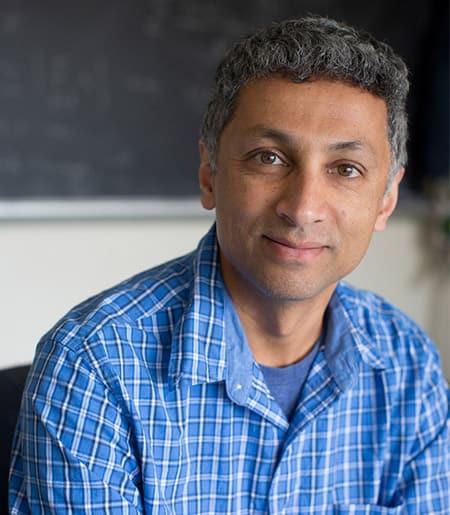
Professor Ravi Ramakrishna

Introduction Card

Ravi Ramakrishna

Professor & Stephen H. Weiss Fellow

Specializes in algebraic number theory

Lecture Abstract

In the 1600s Pierre de Fermat realized the equation x^2+y^2=z^2 had infinitely many solutions in integers, for example (5,12,13), (8,15,17) and (7,24,27). But he couldn’t find any for x^3+y^3=z^3, x^4+y^4=z^4 and higher exponents. He proved there were none for exponent 4 and conjectured there were none for all exponents >2. The problem remained open with slow progress along the way, until the 1993 announcement of a resolution by Andrew Wiles. While Wiles had moved mathematics forward enormously, there was a gap in his proof. In October, 1994 he found a fix, with a timely assist from Richard Taylor. This talk will be about the history of this problem, including the dramatic events of the spring of 1847 in the Paris Academy of Sciences and the eventual resolution of the problem in 1994. Disclaimer: All worked discussed in this talk were performed by actual Human Beings.